Tuesday, December 3, 2013

Dominican Calendar for 2014 Published

As part of the ongoing effort of the vocations promoters of the Dominican Family in Ireland (friars, sisters, contemplative nuns and lay) to promote a greater awareness of the Dominican charism, we have published a Dominican Family Calendar for 2014 - which is available in our Monastery and at Dominican priories throughout Ireland.

 
In January 2011 a prayer initiative was launched to encourage prayer for Dominican vocations to all branches of the Order. The focus of this prayer initiative is an icon of Saint Dominic (show above on the front cover of the Calendar) which has been specially commissioned for this purpose. The launch took place in the monastery of the Dominican Nuns, Drogheda and since then this icon has journeyed to various Dominican centres throughout Ireland - each centre takes responsibility for intensive prayer for a period of 4 to 6 weeks. It is hoped that the image of the founder of the Dominican Order will draw people to reflect on his life and legacy and in turn, through his intercession, draw more men and women to follow the Lord in the Dominican way.

Sunday, December 1, 2013

First Sunday of Advent - 2013


Readings: Isaiah 2:1-5
                 Romans: 13:11-14
                 Mt24:37-44
 

The Mass readings for this first Sunday of Advent provide us with a wake-up call: St Paul tells us “you must wake up now” and in the Gospel Jesus tells us to “stay awake!” while the Prophet Isaias invites us to “walk in the light of the Lord.”  So as we begin a new Church year we are invited to come into the light – to remove the blinds from the windows of our hearts and to let the light shine in – remembering that the true Light is Jesus Himself.  He is the True Light shining on us and who desires to penetrate and posses our inmost being.  

The struggle between light and darkness is a perennial one - it is the struggle in which we are all engaged – the struggle to keep our hearts free and not to allow ourselves to be enslaved by false attractions – the struggle to keep our hearts free for God alone.  It is the struggle about which Paul speaks in the letter to the Romans: “no drunken orgies, no promiscuity or licentiousness and no wrangling or jealousy.” And he advises us: “Let your armour be the Lord Jesus Christ; forget about satisfying your bodies with all their cravings.”   Today there is a lot of darkness in the world around us - at times it would seem that the powers of darkness are let loose but we know that the light will eventually triumph.   More than ever before it is necessary for us to “give up all the things we prefer to do under cover of the dark and arm ourselves and appear in the light.” We must let nothing enslave us or captivate our hearts or impede God’s light and love from shining through our lives to a needy world.  We all know how easily we can be enslaved by trifles – holding on to mere nothings.

We remember how Augustine’s life was transformed while reading this passage from the letter to the Romans: After years of struggle and resistance, in one instant he was free to break loose of his past and come into the light – or rather to allow the light to penetrate and show up the darkness.  All his fears fade away and now he is free to let the light shine in – reminding us of what Paul wrote to the Ephesians: “for once you were darkness, but now you are light in the Lord; ..Take no part in the unfruitful works of darkness, but instead expose them…..when anything is exposed by the light it becomes visible, for anything that becomes visible is light.  Therefore it is said,

“Awake, O sleeper, and arise from the dead,

and Christ shall give you light.”

Just as in the case of Augustine, all our yesterdays lead us to the NOW of today and NOW is always new and different and must mean letting go of whatever hinders us from surrendering to the God who is lovingly awaiting our response.  Can we use these days of Advent to relax in the light of His presence and ask Him to draw back the blinds of our hearts and open our eyes and ears to His love streaming into our hearts?  The following quote from Jean Corbon’s book Path to Freedom seems apt:

“Our ultimate liberation is to open ourselves to a new presence, and the peak of our activity is to relax in the gratuitousness of receiving.  The more He frees us the more He gives Himself.  His gift is a presence of light.  Our task is to open the blinds of our prison and let in the rays of His light.”

 
May this light stream into our hearts this Advent enlightening “the eyes of our hearts, that we may know what is the hope to which He has called us”  and appreciate more deeply what He has already accomplished in us through Baptism – the sacrament of enlightenment - so that a ceaseless hymn of thanksgiving will spring forth from our hearts to “declare the wonderful deeds of Him who called us out of darkness into His marvellous light.”

I finish with this beautiful prayer of St Columbanus:

“Would that my lamp might ever burn by night in the temple of my Lord, that to all entering the house of my God it might give light. …Lord, grant me that love which knows no fall, so that my lamp may feel the kindling touch and know no quenching, may burn for me and for others may give light.  Do you, Christ, deign to kindle our lamps, that they may shine continually in your temple and receive perpetual light from you the light perpetual, so that our darkness may be enlightened and the world’s darkness may be driven from us.”


Sunday, November 17, 2013

33rd Sunday - Year C


The beauty of nature – especially the trees – has been quite stunning this autumn – perhaps it is the result of the beautiful summer and autumn weather we have had.  Walking around the garden these past weeks I have watched the leaves change to various hues of green, gold, brown, yellow and red.  As I watched their beauty increase day by day I was drawn to reflect on the example of the tree.  At the very moment when its beauty seemed to be at its zenith, and one would wish it to remain so for ever, I noticed that the leaves gradually began to fall to the ground.

The trees did not resist but allowed their beautiful garments of leaves to fall one by one to the ground – to wither and die in the soil which in turn will nourish the new growth which will blossom in Spring.  If we look closer we will notice that this new life is already in a tiny bud – hidden and well wrapped which pushes the leaves off the branch.  The tree seems totally detached and is prepared to stand in its nakedness to face the cold frost and snow, the wind and rain of winter confident that this new life will spring forth in all its beauty with the warm rays of Spring sunshine.  And so the cycle repeats itself.

Can I learn something from the example of the tree by being prepared to let go of all that I cherish and that I cling to whether it be real or illusory and be willing to expose my naked being to the “Sun of Righteousness” who shines lovingly on me with “healing in its rays?”  Just as the sap hidden and at work in the tree brings about this rhythm of growth and transformation – of dying and rising again – so the Holy Spirit, the Spirit of Jesus, living in us since our Baptism is always at work within us – even in the midst of all kinds of difficulties, of war and natural disaster, hatred and deception as described in this morning’s Gospel. 

 
This pattern of new birth, growth to full flowering and decay is renewed year after year in nature, and in the process the tree grows in strength and beauty.  Does something analogous to this happen in our spiritual lives if we allow ourselves to be disturbed and guided by God’s Holy Spirit in our day to day lives, confident that we are in His hands and that “not a hair of our head will be lost” as He promised us in this morning’s Gospel.

Friday, November 1, 2013

The Rosary - our Dominican heritage


As October draws to a close it seems fitting to call to mind once again the powerful gift entrusted to us in the Holy Rosary, this extraordinary Gospel prayer in which is so beautifully intertwined our Contemplative gaze on God and our Apostolic outreach to the world and its needs.

One of the most appealing aspects of the Rosary is its versatility. It is truly a prayer for all seasons of life, all stages of growth, all moods and humours.

Through it we can be brought into wrapt attention, lost in God, as the rhythmic cadence of the repetitive Hail Mary stills our bodies, quietens our minds and brings us into the depths of our own being where God simply is and we are simply present with Him.

There are other times when the mysteries themselves hold our attention, coming alive for us. These are times of great reflective fruitfulness when new insights into God and his ways light up our path and renew our enthusiasm for God and the things of God, making it possible for the Word to become flesh in us.

Then there are the days when we feel lost and lonely, anguished and confused and the Rosary becomes our lifeline. We don’t know how to pray .We are too agitated and distressed to quieten down but by picking up the beads and just vocally repeating the prayers we are expressing with our bodies our desire to be one with Jesus in His Sufferings. At these times we are perhaps most truly Mary’s children, sick wounded hurting, fearful for ourselves or for others, but holding on to mammy’s hand and leaving it to her to explain to Jesus the Divine Physician  of our bodies minds and spirits what ails us and what grace we need from each mystery. In each hail Mary we pray ‘pray for us sinners’ but at times like this Mary not only intercedes for us but we leave her to pray for us, do our praying for us. I learnt to pray like this when I was very ill and was too weak to concentrate. Like all loving mothers except much more so, Mary knows us better than we know ourselves and if we just somehow remain there, she will untangle all the knots and the very chains that bind us will be the same ones that draw us with her into Heaven.

At all times the Rosary can be a powerful prayer of intercession but especially in times of suffering and neediness it can move us out of our preoccupation with our selves. We may begin off focusing on the mysteries longing for them to bring us relief but gradually something inside us changes. As we unite our suffering with those of Jesus He gives us his awareness of the needs of all for whom He suffered. He expands our hearts to care for others, to desire their salvation, to want relief for them in their pain, to want them to know as we ourselves know the compassion and comfort of our loving Saviour. In our anguish we can look around us and ask that by his wounds someone else in anguish may have the peace our hearts long for. Our pain becomes a gift when it opens us to the pain of others. It becomes something to be grateful for, something we can even choose to accept if our suffering united to those of Jesus can be of help to someone else. This is the transforming power of the Rosary, this is the mysteries being active in us.

When we have been hurt or when we have hurt others lingering with the sorrowful mysteries can bring healing and penitence. They can teach us how to love, how to forgive, how to understand.

There are times when we are aware of receiving great grace and insight as we pray our Rosary but there are too the long days of simply being faithful to our recitation, allowing the mysteries to unconsciously create the atmosphere in which we live, the very familiarity of the prayer almost imperceptibly making God present, as it were. I always think of my grand parents in this context. At night they would sit together watching TV and as bedtime approached they would turn off the TV and take out their beads. Still sitting together on the sofa they would begin their prayer. By that simply act of taking up the beads, an act as routine as brushing their teeth, a ritual done daily without fail, they changed a place of recreation into a place of deep prayer. To be with them at that time was to be in the presence of God.

As the years begin to creep up on us and old age manifests itself in numerous little ways, making us a little fearful if not of death then perhaps at least of the process of dying, the Glorious mysteries may become specially precious. It is good to reflect on the home coming that awaits us. It helps to look forward in certain hope to the joys of the Resurrection. The Glorious Mysteries remind us that our life is the story of our return to the Father’s house. Jesus has gone before us to prepare a place for us and at the right time He will come to take us to Himself. The assurance that Jesus is coming closer, reaching out to draw us into his embrace where we will be with Him forever provides comfort and brings peace.

Queen of the most Holy Rosary, in life and in death, show unto us the blessed fruit of your womb, Jesus


Wednesday, October 2, 2013

In Praise of the Riches of Autumn


The world is charged with the glory of God – so wrote the poet Gerard Manley Hopkins – glory to Him for all the beauty of creation.

For simple things that we take so much for granted – water supply and food and air, for lions and tigers and grass-hoppers alike – spiders and peacocks and swallows “on the run”.

For giving us food from the soil, brown bread from an ear of corn and wine from the vine to keep us cheerful.

Now in these autumn days we thank you Father for the berries in black-berry bushes and fruits and hazel-nuts – for the beauty of autumn colours with their variety of hues of soft browns and golden yellow orange tints – bright reds to catch the little birds eye.  Praise to you too for those glorious sunrises and sunsets that artists and poets never tire of proclaiming by word or brush.

The eye marvels at all the richness, our minds are stilled and amazed as after the summer heat falls the reviving dew.  Eccl.43

“Harvester God, as the Autumn suns ripen the grain – Ripen our souls too.
As the brown leaves fall and the sheaves of corn are stored away,
help us to leave behind the cares of Summer
and go forward with deepening compassion and trust” – Sr.Marie O.S.U.

“The heavens and the earth are indeed telling of the glory of God,

and all creation is singing for joy - -

Come, come dance through the leaves that scatter our paths

and sing, sing to the glory of God”.

“cf. Canticle of the Sun’’ Marty Haugen

Monday, September 16, 2013

Congratulations to our Dominican Brothers


Our congratulations, prayers and best wishes to the two men who were accepted into the Order on Saturday (September 14th is the feast of the Triumph of the Cross and is also the feast day of the Irish Dominican Province). Also to the four Brothers who made First Profession yesterday and the eight Brothers who renewed their vows on Friday. May God continue to bless you all in your formation as Friars Preachers.

(Images from www.irishdominicanvocations.blogspot.ie ; see that site for more images and details from the ceremonies)


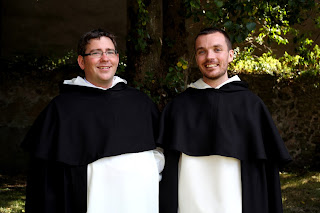
Br Greg Daly and Br Neil Fox were clothed in the habit of the Dominican Order and began their novitiate in Cork


Br Matthew Farrell, Br Philip Mulryne, Br Jesse Maingot and Br Michael (Ronan) O Dubhghaill making First Profession in Saint Mary's Dominican priory church in Pope's Quay, Cork.
The eight brothers who renewed their vows on Friday, pictured with the student master:
Front row (left to right): Fr Terence Crotty (student master), Br Conor McDonough, Br Eoin Casey, Fr Gregory Carroll (provincial) Br Daragh McNally, Br David McGovern.
Back row (left to right): Br Patrick Desmond, Br Damian Polly, Br Ronan Connolly, Br Kevin O' Reilly
The Irish Dominican friars now have 19 in formation at various stages. Please pray for them and those considering joining the Order and the friars who assist them.

Sunday, September 15, 2013

Feast of the Exaltation of the Holy Cross - 14th September


At Vespers this evening we will sing: “This is Love’s great deed that death should die, when life itself was slain up the tree.”  Here we are faced with a paradox – a paradox which human nature has always found difficult to grasp – and which is even more difficult nowadays.  At Lauds we sang: “The holy Cross shines in splendour”; “The holy Cross shines upon us, in the Cross is victory, in the Cross is power.  By the Cross every sin is overcome.”  We may ask ourselves if we experience some of this victory and power in our daily lives. And if not why not?

The following passage from St Andrew of Crete which we read at Office of Readings is particularly beautiful:
We are celebrating the feast of the Cross, whereby darkness was dispelled and the light restored. We are celebrating the feast of the Cross and with the Crucified One we are raised up, leaving behind us the earth and sin so that we may possess what is above. How great the Cross! What blessings it holds! He who possesses it possesses a treasure.  More noble, more precious than anything on earth, in fact and in name, it is indeed a treasure, for in it and through it and for it all the riches of our salvation were stored away and restored to us.


The folly of the Cross is truly a great mystery!  At the very moment when Jesus is most helpless and vulnerable, nailed to the Cross immobile a great hollow space is dug out, as it were, in His heart for us; he reaches out to embrace sinful humanity, He speaks out both His and our ‘yes’ to the Father
as He commends His Spirit into the hands of the Father (Lk 23:46) He donates Him to us (Jn 19:30)
and from His fullness we have all received. 
 

The Cross has always been central to Dominican spirituality – we are all familiar with Fra Angelico’s beautiful frescos of Dominic at the foot of the Cross.  At the foot of the Cross Dominic learned from the ‘Book of Love’ the immense love of our Saviour which led Him to the Cross.  Contemplating the suffering, forsaken Jesus, Dominic’s compassionate heart was torn apart with compassion, firstly, for Jesus whose love was being rejected by the very ones for whom he died.  Paul Murray speaks of an ‘apostolic wound’ – ‘a contemplative wound’ which Dominic received - no doubt the fruit of his ‘special’ prayer when, as a Canon at Osma, he asked God “to grant him true charity, which would be effective in caring for and winning the salvation of all;  giving himself up entirely for the salvation of others. We can say that our Order was born at the foot of the Cross and it is there that each of us must draw our inspiration and zeal.  This too is the source from which renewal will spring. 

In his correspondence with Blessed Diana, Blessed Jordan exhorts her always to have before her eyes “the book of life, the book of the Lord’s perfect law which brings life back to souls”.  And he continues:
this law is charity: you see it when you gaze on your Saviour Jesus stretched out on the Cross, as though a parchment, his wounds the writing, his blood the illuminations. Where, I ask you, my beloved, could the lesson of love be learnt as it is learnt here?

And according to St Catherine of Siena, Dominic wanted his children to
stand at the table of the Cross – to seek only the glory and praise of God and the salvation of souls
As we take our place with Dominic and Mary at the foot of the Cross we begin to understand the meaning of our vocation.

The Cross and Veritas

There is a very close link between the Cross and Veritas (Truth) - the motto of our Order.  “The Cross verifies the truth about God and the truth about humankind”.

The truth about God: When we look at the Cross we are left in no doubt of God’s infinite love –This is how God loves.

The truth about humans:  the Cross reveals the dignity of every person – how precious we are in God’s sight that He should die for us!

But the Cross does not rob us of joy – the contrary is true as we sing in the liturgy: “through the Cross joy has come into the whole world” and with it freedom.  Jesus has taken the burden of our sin on Himself and has already achieved our eternal salvation.  Our task lies not in anxious striving to achieve our own perfection but in opening ourselves to receive the gift. “At the very moment when he identifies with our sin, ‘abandoned’ by the Father, Jesus ‘abandons’ himself into the hands of the Father”. We in our turn can abandon ourselves and those we carry in our hearts to the loving mercy of our God in the sure hope that “all will be well”.