Thursday, August 28, 2014

Another Jubilee Celebration


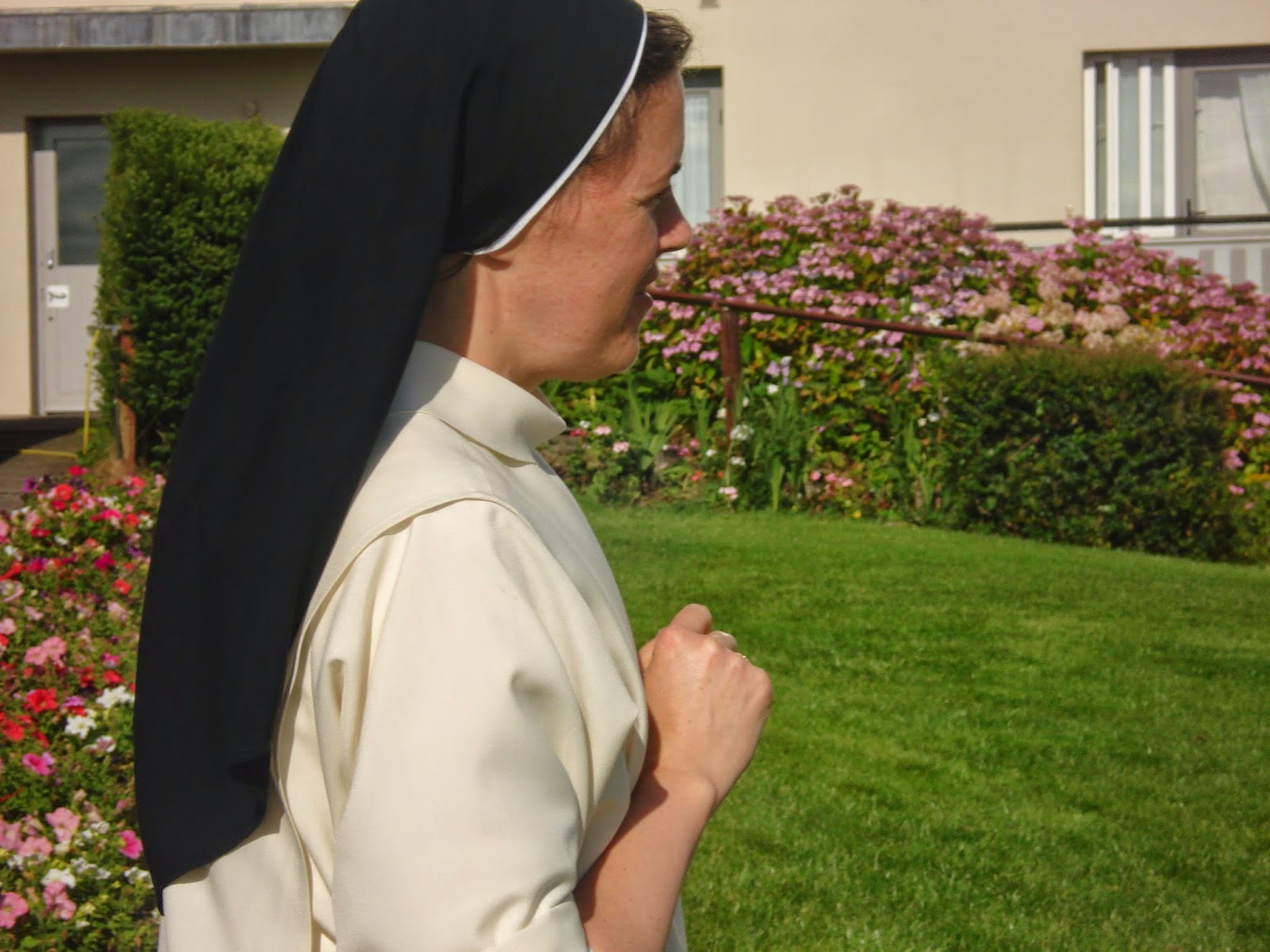
These past two weeks four of our sisters have been participating in a theology course for Contempaltive nuns, hosted by the Redemptoristine community, Dublin.  So we are rather late in sharing some pictures of Sr M Dominika's Silver Jubilee of Profession - celebrated on the 13th August -  Fr Gerard Dunne OP, Vicar of the Master of the Order for our monastery, was chief celebrant at Eucharistic celebration and Fr Anthony McMullan OP, from the local priory concelebrated with him.  It was just a community celebration but nonetheless a very joyful occasion.  We had a special recreation in the afternoon and afterwards the more agile among us had a game of hurley in the garden - could one call it a game? or just having fun?  Even Dobby the cat came to watch them.  We hope to publish Sr M Dominika's very interesting vocation story here shortly - leading her all the way from her native Belarus via Vilnius, Krakow to Drogheda, Ireland - so keep an eye out.
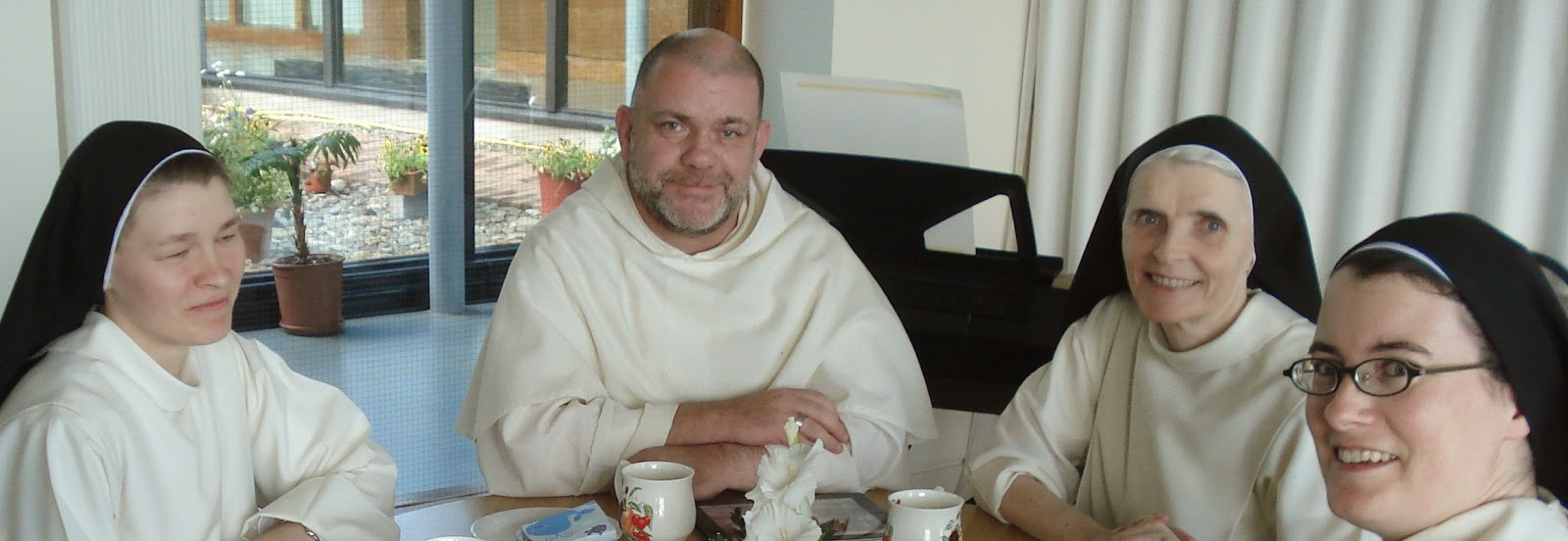


Sr Dominika with Sr Regina who celebrated her Golden Jubilee and Sr Margaret who celebrated her Diamond Jubilee recently.


Sr M Pascale enjoying the fun


Friday, August 8, 2014

Our New Website


We have a new website!! Check out the link here - lots of new photos!

 Many thanks to our dear sister in St Dominic,
Leah Gaines OP for all her hard work in redesigning our website. She did a great job.

Thursday, August 7, 2014

Novena to St Dominic 2014 - Day 9


These past days we have been reflecting on the life and virtues of St Dominic and his zeal for the salvation of souls.  Blessed Jordan of Saxony concludes his Libellus (a short history of the beginnings of the Order) with the exclamation: “who could ever hope to imitate the virtues of this man Dominic?” and he continues: “we can however admire them and weigh up the slackness of our own generation against his example.” 

In the face of Dominic’s virtues Jordan more or less felt that we could never reach that holiness without an extra special grace – somehow we hear a certain resignation in his tone as he encourages us to “follow in our father’s footsteps to the best of our ability.”  But I’m sure Dominic himself would have something different to say to us.  No doubt, Dominic was convinced that God’s infinite love and mercy which were the source of his strength and his zeal, were available to all his children.  He was always aware of how much he himself stood in need, totally dependent on God’s infinite mercy and in prayer frequently called out for that mercy: “Lord what will become of sinners!”  Although Dominic preserved his Baptismal innocence throughout his life this was not the result of any merit on his part – he knew that he stood in need of God’s infinite mercy as much as the greatest sinner.  I think that Dominic’s wish would be that each of us become the person we were created to be – not a replica of himself.  We see this from his respect for individuals – a respect which has been a characteristic of the Order down to the present day.  Often our discouragement stems from our efforts at trying to imitate someone else or while being blind to what the Lord is doing in our own hearts.  In this morning’s homily we were reminded that our “true identity is based on the fact that we are children of God, created in his image with a role in life that no other can fulfil – to really know this in one’s heart and to live accordingly as Dominic did, is surely the road to unending happiness” and holiness.

Dominic’s joy and cheerfulness surely sprang from this knowledge of being loved infinitely – fruit of his many hours of contemplation of the Crucified Saviour.  Jesus has saved the world and taken on Himself the sins of all of us – now He desires that we open our hearts to receive the gift of His love and in freedom to live by that love. This gift is available to all of us if we allow that area of our heart to be spoken to.  But am I willing to open?  In today’s world there is great emphasis on effort but our effort  must be rather more faith and trust, letting go and letting God do His work.  All our yesterdays lead us to the now of today and now must always be new and different and must mean letting go as fully as possible and let myself live more and more out of the gift of God.

As we celebrate this feast may we experience some of the joy which Dominic had in his heart and may he intercede for us with the Lord Jesus that we too may be given the gift of true charity to enable us to spend ourselves and let ourselves be spent in the service of our Lord and Saviour and of our brothers and sisters.


Wednesday, August 6, 2014

Novena to St Dominic 2014 - Day 8

As we approach the end of Novena to St. Dominic. I would like to share a thought on the fourth way of prayer of St. Dominic.

"St. Dominic, standing before the altar or in the Chapter Room, would fix his gaze on the crucifix, looking intently at Christ on the cross and kneeling down again and again.  Also at times, he spoke in his heart and his voice was not heard at all, and he would remain on his knees, his mind caught up in wonder, and this sometimes lasted a long time. Sometimes, when he was praying like this, his gaze seemed to have penetrated into the spiritual heavens, and he would suddenly be radiant with joy, wiping away the abundant tears running down his face. At such times he would be in an intensity of desire, like a thirsty man coming to a spring of water, or a traveller at last approaching his homeland. His prayers became stronger and more insistent; his movements rapid yet always sure and orderly, as he stood up and kneel down."


Today is the feast of Transfiguration. And it seems to me that this prayer of St. Dominic is closely related to this feast. When the apostles saw Jesus transfigured they were overcome with wonder, amazement and deep joy. Maybe they also had to wipe away their tears. When St. Dominic was looking at Jesus on the cross and was overcome with joy, his joy was not only for himself, but for others. When we gaze at Jesus, we too become more and more aware - as St. Dominic did - of the mercy of God: and not only for ourselves, but for all sinners, for the whole world. With the apostles on the mountain, and St. Dominic at the cross, we pray "Lord it is wonderful for us to be here."

Tuesday, August 5, 2014

Novena to St Dominic 2014 - Day 7

Today's Gospel forms a very good starting point for my reflection on St Dominic.

I have sometimes heard homilies on this passage along the lines of: Peter showed great faith, he stepped out of the boat and started walking towards Jesus. But then he took his eyes off Jesus and instead of being focused on Jesus he started thinking about what he himself was doing and so he began to sink.

Dominic was a man of great faith who repeatedly acted from that faith - sending out his first followers to make foundations in different parts of Europe, his many miracles etc. And I think what nourished/produced this faith was that he lived with his gaze firmly fixed on Jesus. We see this particularly in the record of his prayer practices, "The Nine Ways of Prayer." He often prayed before a crucifix, "looking intently at Christ on the Cross" and speaking with Him "in his heart." He spent long periods praying and meditating on the Gospels - "It was as though he was discussing something with a friend" and would spend his journeys reflecting on some passage of scripture.

May we learn from him how to live with our eyes fixed on Jesus and so come to greater faith and intimacy with God.


Monday, August 4, 2014

Novena to St Dominic 2014 - Day 6


As we continue our novena I would like to focus on St Dominic’s love of and fidelity to prayer and his ease at praying all through his life especially at moments when he had to make important decisions.

Today the 4th of August we celebrate the feast of St John Mary Vianney who also was a great man of prayer.  Yesterday at Sunday Mass we read the Gospel of Matthew (14: 13 – 14) where Jesus needed to get away from the crowds to pray and grieve for the death of John the Baptist but because of the pressing needs of the crowds he did not get it.  In today’s Gospel following on from the feeding of the multitude and sending the crowds away Jesus goes up into the hills to pray.

Very often St Dominic is addressed in   poems and hymns as ‘Gospel man of Prayer’. Theoderic says: “A certain cleric after hearing Dominic explain the Holy Scriptures could not refrain from asking him in what book he had studied to find matter so sublime”  “My son” replied the saint “I have studied chiefly in the book of Charity, it is there that we learn all things.”  Dominic must have spent many hours before the Crucifix which inspired him to go far and near preaching the Word of God, visiting the poor, consoling the afflicted, healing the sick in imitation of his Lord and Master, Jesus Christ.

Dominic we are told by those who knew him “spoke only to God or about God.  Biographers tell us when he was on his journey with a band of friars he would remain at the end to be alone and pray.  He was often heard singing the hymn to Mary “Ave Maris Stella”.

At night he spent much time praying, resting his head on the altar steps.  Blessed Jordan of Saxony says  that God gave him the singular grace of weeping for sinners, the wretched, the afflicted.  Day and night Jordan says Dominic prayed without ceasing and using the leisure time afforded for contemplation.

Abbot William of Toulouse at the saint’s canonisation process said “I never saw anyone pray so much or weep so much.  When he prayed he cried out and could be heard by those around him and in these cries he said: “Oh Lord have mercy on your people – what is to become of sinners? - thus he spent his nights imploring, praying for the sins of others.”

Dominic grasped the importance of the liturgy – Mass and the Divine Office.  We are told “none was more fervent when celebrating the Eucharist.  Almost always when he was outside the priory when Dominic heard the first bell for Matins from a monastery he arose and aroused the brethren.  With great devotion he celebrated the entire day and night Office in proper order.  Rudolf of Bologna said “the Blessed Dominic always attended choir with the community”.  When he was there he used his prerogative as father and founder to encourage them “to put their whole hearts into the chanting.” 

Many of us are familiar with the ‘Nine Ways of Prayer’ where Dominic gives us the example of using his body in genuflections, standing and prostrating before the Altar and Crucifix.  Dominic was very aware that we are more than spirit and soul – we are flesh and blood people too.  If our prayer is to be an authentic expression of our faith then devotion and worship must also have a corporal dimension to it. 


I conclude with a prayer to St Dominic for all of us and an increase in numbers.


Joyful friar,

Tolerant master,

Grace-filled preacher.

Gospel man of prayer

Pray that your sons and daughters

May be faithful to you heritage

Of common life

Common prayer

Study

And service

And that other men and women will join them

To praise

To bless

And to preach

That Jesus Christ is Lord.  Amen


Sunday, August 3, 2014

Novena to St Dominic 2014 - Day 5

On reflecting on today’s readings at Mass and on St. Dominic during this novena in his honour, I was struck by how closely Dominic resembled Jesus – how Christ-like he was.

In the Gospel this morning, Jesus, needing to be by himself with his disciples to mourn the violent death of John the Baptist, put aside his own needs for the sake of the crowds who followed him. Experiencing compassion for them, he preached the good news to them, healed their sick and fed them – giving them both temporal and spiritual sustenance – caring for the spiritual, moral and physical needs of the people.

Dominic, likewise, put the needs of others before his own. In fact ‘Dominic’s life was shaped by the needs of others,’ Simon Tugwell says. This idea of Dominic’s life been shaped by the needs of others and the reality behind it has stayed with me – sometimes to ponder with admiration Dominic in his own person and the mission of the Order and sometimes too in the challenges it poses for me, as I direct this question to myself. Is my life shaped by the needs of others? – or do I live an individualistic, selfish existence? I like the phrase coined by Timothy Radcliffe when he says:

“Dominican Spirituality is about living in God and for others”.

The Gospel message is clear and consists in giving one’s life for others as Jesus did and as the greatest expression of his love for us: in the text:

“And the bread that I shall give is my flesh, for the life of the world” ( Jn 6:51)

The Eucharist is actually prefigured in today’s Gospel with the taking, blessing, breaking and giving of the five loaves to the people. Jesus not only gave his life for us but continues to live in us, loving us, strengthening and sustaining us by his presence and grace.

From the beginning to the end of his life we are given proof that Dominic’s life was indeed shaped by the needs of others. “Dominic was a man unusually responsive to the world around him. A realist as much as a visionary, he stood out among his contemporaries not only as a man of God, but also as someone notably quick, flexible and generous in his response to the immediate demands of history”( p.15 Preachers at Prayer – Paul Murray O.P.)

That sense of openness to the world is a marked characteristic of many of the great Dominican preachers, ‘When I became a Christian,’ noted Lacordaire, ‘I did not lose sight of the world’. And, in a similar vein, Vincent McNabb remarked once to some of his brethren: ‘The world is waiting for those who love it…If you don’t love men don’t preach to them - preach to yourself’!  (p.16 Preachers at Prayer – Paul Murray O.P.) Dominic had this tremendous, genuine love for people – he cared deeply for them. We are told that “his heart was full of an extraordinary, almost incredible, yearning for the salvation of everyone”. (Libellus 34)

These are just some of the ways he put the needs of others before his own:

  • As a student he responds to the needs of others by selling his precious books to help relieve the distress of famine victims.
  • He stayed up all night and argued powerfully and passionately with an innkeeper who was a heretic and brought him back to the faith.
  • He changes his whole way of life in a dramatic way from being a Canon Regular to an Itinerant Preacher.
  • He heals many people and performs other miracles in his lifetime.
  • He founds an Order for ‘preaching and the salvation of souls’ – totally directed towards the needs of others, towards their salvation – their greatest need.

How did this come about? – that Dominic’s life was shaped by the needs of others? Because, as Vicaire tells us, his deepest inspiration was his love of Jesus Christ.

Another historian William Hinnebusch, reinforces this attribute of Dominic, when he says:

‘Endowed with a charm and compassion that drew both men and women

            into the orbit of his love, his dominant trait was a priestliness that was

            marked by a profound love of Christ and the Eucharistic Mystery.

 Dominic’s profound love of Christ could only be a response to his awareness of God’s love for him and very much aware of that love lavished on himself by God, he shared it with others.

 Reading through the early accounts of his prayer-life, what immediately impresses one is the place accorded to others – especially to the afflicted and oppressed.

In this regard Jordan of Saxony writes of Dominic:

“God had given Dominic a special grace to weep for sinners and for the afflicted and oppressed; he bore their distress in the inmost shrine of his compassion, and the warm sympathy he felt for them in his heart spilled over in the tears which flowed from his eyes”

Paul Murray O.P. in his book, The new Wine of Dominican Spirituality. A Drink called Happiness, has a beautiful passage in reference to this special grace, given to Dominic. He says:

“the wound of knowledge that opens up Dominic’s mind and heart in contemplation, allowing him with an awesome unprotectedness to experience his neighbour’s need, cannot be accounted for simply by certain crowding memories of pain observed, or by his own natural sympathy. The apostolic wound Dominic receives, which enables him to act and to preach, is a contemplative wound.”

My prayer is that through the intercession of St. Dominic, all of us might receive this contemplative wound, this same special grace, which will deepen our love for Christ and our communion with the Blessed Trinity, allowing our lives to be shaped by the needs of others, especially through ceaseless prayer and the humble and loving service of our sisters and brothers.