Showing posts with label Sunday Gospel. Show all posts

Sunday, March 8, 2015

3rd Sunday of Lent - 2015


Destroy this sanctuary and in three days
        I will raise it up .
He was speaking of the sanctuary that was his body.

Reading this passage in to-days Eucharist on the cleansing of the Temple I was struck by the intensity of Jesus’ zeal for the purity and integrity of his Father’s house.
His attitude had always been one of immense respect for the temple as many incidents related in the Gospels tell us.    The prophecies had foretold of the destruction of the ancient temple which would be replaced by the New Temple, a temple of the living God, Jesus himself, who would offer to the Father the true worship in Spirit and in truth.
        This theme of the true temple can be traced right through the scriptures to reveal that “Jesus has truly transferred to his own person the privilege, long held by the temple, of being the place where mankind would find God’s presence and salvation.”( Congar  The mystery of the temple) It makes for a fascinating study but is too long to go into detail here.
     Thro’ the mystery of the Incarnation Jesus becomes for us the image of the invisible God, the one whom the gracious Father with love sends into our world to draw it back to Him who first created it.  We thro’ our baptism are incorporated into the life of this Jesus to be come thro, with, and in Him,  temples of the Blessed Trinity.
 Will we ever be able to fathom so great a mystery? a mystery which touches us not only as individuals but as a community and Church.
“ Do you not under stand that you are God’s temple and that God’s Spirit has his dwelling in you ?   He is God’s gift to you so that you are no longer your own masters.   A great price has been paid to ransom you ; glorify God by making your bodies the shrines of his presence. 1 Cor.
         “ A great price has been paid to ransom you”, yes indeed ,that of the immolation of Christ’ s body which would be raised up again on the 3rd day, in other words His loving and whole-hearted submission to the will of his Father leading him to the glory such as belongs to the only begotten Son.  .Here we are at the heart of the whole work of Jesus, the work which the Father had given him to do.  And is not this our work too, we who are his brothers and sisters?  The Church encourages us in Lent to stir up our memory and conscience to that fact as we journey with Jesus to the glorious transfiguration of the Resurrection .     The witness of so many of to-day’s Christians who are ready to shed their blood for Christ spurs me on to deepen my faith, my hope ,my love for the blessed Three who dwell within me .
All praise, O Blessed Trinity,
Be yours, from whom all graces flow,
On those who triumph through the cross

The victor’s crown in heaven bestow.

Sunday, July 7, 2013

A Vocation Story

Since today's Gospel is the sending out of the Disciples it seems appropriate to share Sr Mary Cathy's vocation story: how she recognised/discovered where our Lord was calling her to work in his vineyard.

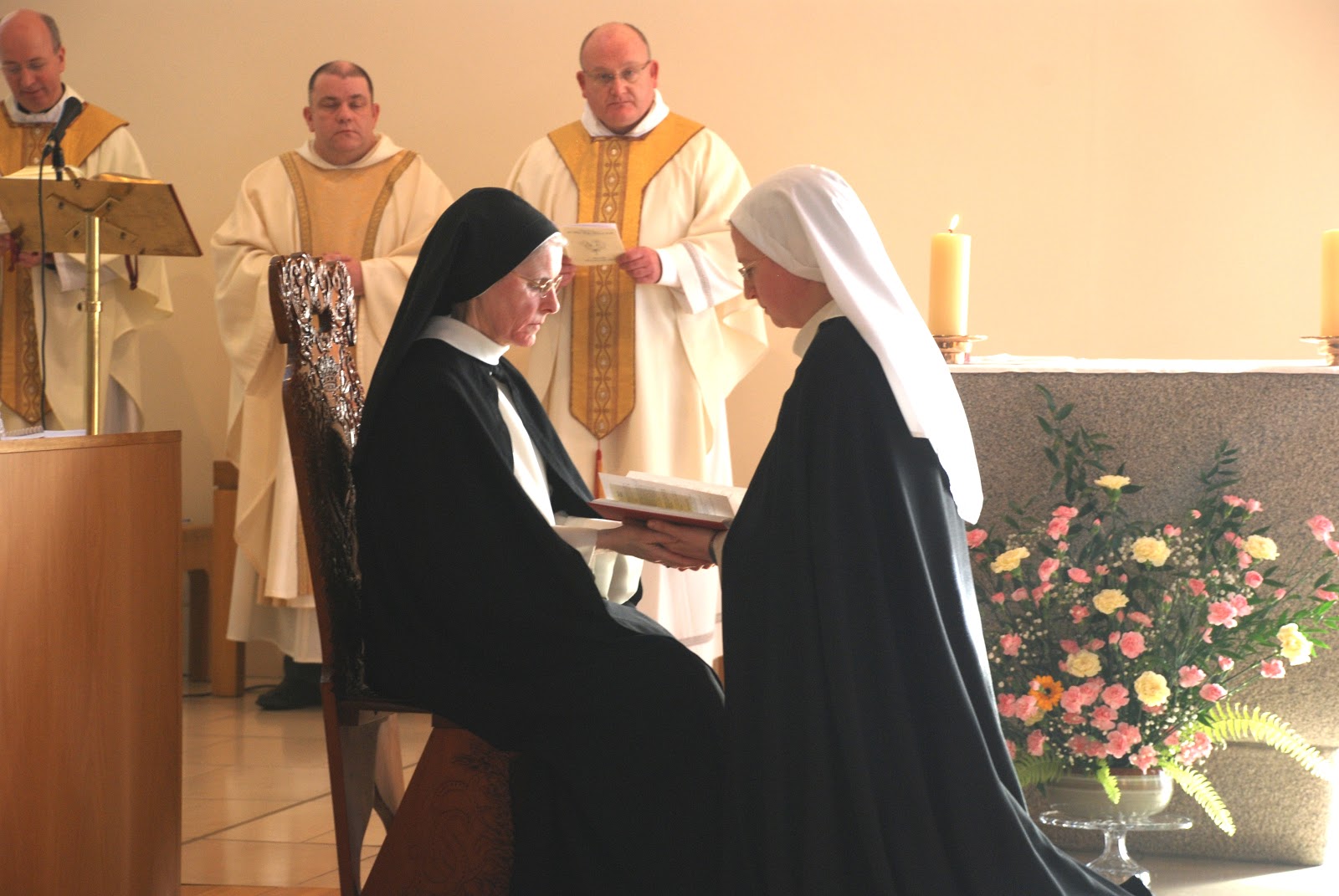
Sr Mary Cathy making First Profession, 2nd February 2013
My name is Cathy Howard. I am 32 years old and I come from Finglas, Dublin. Both my parents are living and I have four brothers, two sisters and nine nieces and nephews. I entered the Monastery of St. Catherine of Siena in Drogheda, County Louth, in April 2010. I spent nine months as a Postulant, two years as a Novice, and made my First Profession on the 2nd February 2013.

I did not really know anything about God or the Church until I got involved with the Legion of Mary in 2004. A member of the Legion working in the Regina Caeli Hostel, encouraged me to go to Confession – the Sacrament of Reconciliation, and so I did. This was the first time I had gone to Confession since my First Holy Communion. I spent two hours with the priest and it was during this Confession that I experienced God’s love, mercy and forgiveness. For the first time in my life I felt free and alive. This was the beginning of a new journey for me. I was to spend many more hours in confession during my first years following my conversion. This sacrament continues to be a great source of healing for me.

I became a member of the Legion in 2005. Part of the Legion’s work is door to door visitation by two members. I found this work very challenging as I had very little knowledge of the teachings of the Church and found myself for the most part, to be the one praying for the guidance of the Holy Spirit on my companion who spoke, and on the people whom he/she addressed. While doing this work I learned so much myself about the faith.

In the first years of my conversion, going to daily Mass and Eucharistic Adoration were essential for me – I felt I could not live without them. It is even more so the case today. I attended many Youth 2000 retreats all over the country and also went for weekend or week long retreats to a retreat house in Scotland, called Craig Lodge. This retreat house is run by a married couple and there are 8-11 people, of my own age, living and working there as a community- looking after the retreatants who come there. What attracted me greatly to this retreat house was the fact that Morning, Evening and Night Prayer were sung daily and there was adoration of the Blessed Sacrament throughout the day. I felt attracted to joining this community and felt that there was where the Lord was drawing me. To join, it is necessary to do one or two years formation with them and I asked if I could come and stay for a week or two to see if it was for me. They agreed and I went the following December for two weeks but could only stay four days as I had to return home due to an urgent family situation. I went back many times after that but never joined them.

In the first year of my conversion the company I was working for, went into liquidation and it was some time before I got another job in a sweet factory in Finglas. In the work place I seemed to be the only one who had the faith and was not afraid to speak about it, but I felt very much out of place in that work situation, as if I did not fit in at all. It was the Lord alone Who kept me going in that job for two years. I used to begin to pray the rosary on the way to work as I walked to the bus, getting three decades said, and then continued the remaining decades on the bus itself. After that I took out my breviary and began to pray Morning Prayer. I used to get the funniest looks from the people sitting beside me but I did not care in the least. I knew this was the only thing that would get me through the day as work started at 7:30 am and I would have to wait until after work to go to Mass – which was great to look forward to. During this time my faith was growing and my relationship with the Lord becoming stronger and deeper. I spent most weekends away on retreat and during the week I would spend time each day in adoration.

Eventually the factory closed following a fatal accident and the idea of joining a community for a year or two came to my mind again - since I was out of work I thought it might be an opportune time. However, on the advice of a friend I took time to think and pray about the situation as he said that if I were to join a community for a year or two I would still have to return to Dublin with no job, flat, money etc. It was a real test for me to see how much trust I had in God’s providence – that he would look after these things for me.

I prayed about this and remember sitting in Adoration in the presence of the Lord and pouring out my heart to Him – saying that if it was His will that I put the formation year in Craig Lodge out of my mind, then, that He would help me find work with people who had faith and on the south side of Dublin as I could not bear working in Finglas again. ‘Not my will but Yours be done’ – I prayed.

Weeks or months after making that prayer – I can’t remember how long exactly, I received a phone call from a friend asking if I would be interested in working for a period of seven weeks, in a Carmelite Monastery, making altar breads and this monastery was on the south side of Dublin! If that is not an answer to prayer then I don’t know what is!

I accepted the job and really loved this work. I attended Mass with the sisters and prayed the Divine Office with them before I started work and then for my lunch break I would sit in prayer with the Lord in the chapel. After a while the sisters let me use their own little oratory where I could expose the Blessed Sacrament. Until I worked there, I never actually thought about where the altar breads came from even though the priest reads from the missal everyday at Mass ‘….. Through your goodness we have received the bread we offer you: fruit of the earth and work of human hands, it will become for us the bread of life’. I really could not believe that I was making altar breads knowing that the bread was going to be changed into the living and true flesh of Jesus Christ. This blew me away.

The seven weeks turned into eleven or twelve weeks and when it was time to leave my heart was breaking. One day the Prioress took me by surprise and asked me to stay behind after work as she wanted to talk to me. She asked me if I ever thought of Religious Life? “No way, I said. I was not humble enough”. She laughed and said that none of us are. I must have mentioned that I was interested in joining a community for a year’s formation but never thought of Religious Life, especially the enclosed type. She said that I had the capability for it and that I was very balanced. I really could not believe this was happening and I remember going home very excited that day. I spoke to my spiritual director and he was very encouraging.

Working for, and praying with that Carmelite Community was very important on my faith journey and I am very grateful for that period of my life. At this stage I also started looking at other communities and I thought about a fraternity, the Fraternity of Mary Immaculate Queen, whose members had become good friends of mine. We set a date for a month’s live-in/trial with them but something happened at the last minute and I was unable to do it.

When I first came back to the Church I used to come to the Dominican Church (St. Saviour’s Community, Upper Dorset St., Dublin 1) in Dominick’s street, for Mass and Morning Prayer on my days off. I also attended the weekly Divine Mercy Holy Hour. I had a tremendous healing experience during a Novena to St. Martin in 2004 and since then I have had great devotion to him. I would never pass the church without going in to say a quick prayer and light a candle. Over the years I got to know the priests and students very well and you could almost say that I had became part of the furniture! I felt very much at home there. My heart was there.

I remember sweeping the floor at work one day and really feeling that the Lord was calling me to religious life. But where was the question? This conviction was very strong and I spoke about this to my spiritual director. As he pondered on my situation and knowing how attracted I was to Eucharistic Adoration – how it was my lifeline –it was then he told me about the Dominican Nuns in Drogheda- how they have Eucharistic Adoration all day, how they sing the Liturgy beautifully and pray the rosary daily. I had never heard of them before – it was only the friars that I knew from the Dominican Order. I was really taken by all of this and thought that this may be where the Lord was leading me to. They hold vocation weekends every couple of months and when I rang, the Novice Mistress said that there was a weekend coming up soon and that I was welcome to attend.

I was so nervous about going that my spiritual director drove me to the monastery and left me in the chapel. I remember feeling a beautiful Presence when walking in. After the weekend I knew that there was where the Lord wanted me to be. During the weekend, when talking to the young sisters I mentioned that I was not too keen on the study because I had missed out on some of my education, due to a medical childhood condition and family circumstances. One of them put my mind at rest when she said that if you are passionate about something or if you are in love with someone you want to know everything about that person and that it was the same for us with the Lord – we study for the sole purpose of growing in the knowledge and love of God and for no other reason.

My parents did not take the news of my entering too well, especially because of what the media was saying at the time. My Mam did say that as long as I was happy she would be happy but I knew she was hurting inside. However, my parents and most of my family have been very faithful in visiting me. The Lord said “Everyone who has left houses, brothers, sisters, father, mother, children or land for the sake of my name will be repaid a hundred times over, and also inherit eternal life”. ( Mt. 19:29). I now feel a new bond with my family that was not there before and I am very grateful for it.

Sunday, June 16, 2013

Reflection on the Gospel for the 11th Sunday of Ordinary Time

I was deeply struck by the audacity of the woman in today’s Gospel and found myself asking how did she come by such inner freedom? What inner force made it possible for her to act so spontaneously and uninhibitedly?
Perhaps I am way out, but I venture to say this was not her first encounter with Jesus. This is not a chance meeting. She is deliberately going to Simon’s house because Jesus is there and she brings ointment with her because she knows what she wants to do when she gets there. This woman knew who she was going to and was sure of the response she would receive because she had already been a recipient of Jesus love and knew herself to be loved and forgiven.  She knew that Jesus was aware of the purity and sincerity of her love for him. At some time this woman of ill repute, very familiar with all that can masquerade as love and it many caricatures, had recognised the real thing when she encountered it in Jesus and it had changed her. Now she really is in love and knows herself to be loved perhaps for the first time.
A woman whose self image was so poor that she allowed herself to be used to gratify others is suddenly sure of herself and is undaunted in the presence of men who belittle and despise her. This is the power love has. When we know we are loved fear falls away. Instead her sole focus is on Jesus. She has heard he is here at Simon’s house and she arrives complete with ointment with only one thought in mind to minister to her beloved.  With total disregard to how others would react, this would be prostitute interrupts the all male gathering and proceeds to kiss Jesus, wash his feet with her tears, dry them with her hair, and massage the with ointment brought specially with her for that purpose. What has wrought such a transformation? Jesus tells us himself: I tell you, he says to Simon ‘her sins her many sins, must have been forgiven her, or she would not have shown such great love’. Nothing prompts a response of love like the awareness of being forgiven. That is why great sinners often become great saints.
Simon and his companions look on and judge: judge her and judge Jesus. In both cases their judgement is erroneous. Jesus does know what kind of a woman is before him, a repentant sinner who loves him very much. He can read her in a glance as expected of a prophet, but as a true prophet his vision is clear. He sees what actually is. He sees her present not her past. All her gestures may have similarities to her past mode of activity but to Jesus who sees the heart, they are an expression of pure love, a love so overwhelming and so grateful that it needs must express itself extravagantly.
Jesus is utterly comfortable in the presence of such love. He is not embarrassed by it. In fact when he speaks he supports the woman and commends her actions, indicating that he prefers her demonstrativeness to Simon’s propriety which he finds wanting.
Simon on the other hand, because he is blinded by her past and who he thinks she is, is unable or unwilling to see her present. He is wrong about her and perhaps because he is so focused on her and all that is wrong with her, he fails in self-knowledge and Jesus has to confront him with his own behaviour, making him see what his actions are revealing about himself. He had in fact shown very little love and his omissions were supplied by this very woman whom he was condemning.
Jesus turns to the woman and just as her sins have been matter for public knowledge, so now he makes her forgiveness public. What she already knows, he makes known to others, leaving no doubt about her standing in his eyes.
I ask myself
  1. Do I really believe in the transforming power of Jesus love for myself and others
  2. Am I open to seeing that love changing others or do I hold them to their past.
  3. Do I impede or assist this process

Sunday, November 4, 2012

Reflection on the Gospel - 31st Sunday of Ordinary Time

In today’s Gospel, we see an anxious Scribe asking Jesus, ‘which is the first of all the commandments?’ Jesus replied. ‘This is the first: Listen, Israel, the Lord our God is one Lord, and you must love the Lord your God with all your heart, with all your soul, with all your mind and with all your strength’ – heart –soul – mind, strength, these are extremely strong words; if we stop to ponder them deeply, each contains a great depth of meaning, a call to give our love totally to God with every fibre of our being. Most of us are familiar with these words of Jesus. For myself, it is loving God with all my heart and soul and strength, that has always struck me forcibly, but reflecting anew on this Gospel text, it was the word ‘mind’ which drew my attention today.
What does it mean to love God with all my mind? At first sight it sounds very intellectual and even calculating, though we do speak of a person having a beautiful mind, or of someone asking us to be mindful of them in our prayer or in some other way. Our minds are indeed a very precious gift from God.

But it is the heart which is known world-wide as a symbol of love - we hear people say ‘I love this or that person with all my heart, but I have never yet heard anyone say, I love you with all my mind, there would surely be a few raised eyebrows, to say the least!

It is interesting to note that the Scribe who asked Jesus this question responded by saying: ‘Well spoken, Master; ……to love him with all your heart, with all your understanding and strength….this is far more important than any holocaust or sacrifice’. He uses the word ‘understanding’ instead of ‘mind’ and this gives us the insight we need to ponder and reflect upon.

St. Paul enlightens us further when in his letter to the Philippians 2;1-6 he says; ‘ If in Christ there is anything to move you, any incentive to love….I appeal to you, make my joy complete by being of single mind, one in love, one in heart and one in mind. Make your own the mind of Christ’, he entreats us, ‘who being in the form of God, did not count equality with God something to be grasped but he emptied himself.’ To be called to make our own the mind of Christ is indeed a profound, even fearful, challenge.

St. Paul throws further light on this call to love God with our minds as well as our hearts ,when in his letter to the Romans 12:1-2 he pleads with us ‘I implore you by God’s mercy to offer your very selves to God – a living sacrifice….the worship offered by mind and heart’. Further on in the same letter he again exhorts us ‘let your minds be re-made and your whole nature thus transformed. Then, and only then, will you be able to discern the will of God and to know what is good, acceptable and perfect’.
For those of us called to the Dominican way of life, our Rule reminds us the first reason for which we are gathered together in community is to live in harmony having one mind and heart in God.

In this year of Faith which our Holy Father Pope Benedict has inaugurated, he says in his Apostolic letter: ‘ever since the start of my ministry as Successor of Peter, I have spoken of the need to rediscover the journey of faith so as to shed ever clearer light on the joy and renewed enthusiasm of the encounter with Christ’… he goes on to say ‘we must rediscover a taste for feeding ourselves on the Word of God…and on the Bread of life. What the world is in particular need of today is the credible witness of people enlightened in mind and heart, by the Word of the Lord, and capable of opening the hearts and minds of many to the desire for God and for true life, life without end’.

Pope Benedict ends his Apostolic letter by inviting us to ‘entrust this time of Grace to the Mother of God, proclaimed ‘blessed because she believed’. (Lk:1.45)

Responding generously to the appeal of Pope Benedict, with the help of God’s ever present Grace, we will truly be responding to today’s Gospel passage i.e. to ‘to love God with every fibre of our being , heart, soul, mind and strength’ as Mary did.

Monday, March 26, 2012

5th Sunday of Lent

The Gospel passage we read at Mass today from St. John, is very full and pregnant with food for thought and reflection as we approach the holiest week of the year. As I reflected on the text I could see glimpses of the entire life of Jesus from the beginning of his public ministry, his death, Resurrection and glorification – a text that can surely help us ‘come to know the Lord’ and put us in touch with what is happening at this stage in his life.

The pilgrims are arriving in Jerusalem for the feast of the Passover, including some Greek converts who want to “see Jesus”. This is the desire in the heart of all of us. “I would like to see Jesus”. Jesus responds as He always does throughout the Gospels, and very pointedly in St. John’s Gospel, which always has many layers and levels of meaning, e.g. in response to “where do you dwell?”, Jesus says “come and see”. In response to John the Baptist’s disciples' questions – “are you the one who is to come or are we to look for someone else”? Jesus’ replies “go and tell John all you see and hear – the blind see, the deaf hear – lepers are cleansed and happy the one who does not lose faith in Me”. Here in our text today Jesus’ reply was “Now the hour has come” the kairos time of God for the ‘Son to be glorified’ is at hand. His words or his reply to the questions are never direct, but they are authenticating who He is.

“I tell you most solemnly unless a wheat grain falls on the ground and dies, it remains only a single grain, but if it dies, it yields a rich harvest. Even the ‘dead grain of wheat yields a rich harvest’. Seeds left in a packet are no good. Plant them, they die, they multiply, they flower and they bear fruit. Jesus observed this principle of life within the natural world, namely, that life is born from death. Until the seed is buried, it remains one, if planted, it will produce many. Jesus saw his own death mirrored in this process of nature. He lived to die and his death meant life for the world. This opens a horizon for us where all our little deaths are understood in a new way. Jesus has gone before us and understands all our struggles and efforts at dying and we are confident that he is with us. We also have the example of Mary and all the saints gone before us who had to die in order to have real life with Christ. Tomorrow we celebrate the transferred feast of the Annunciation and there we see clearly, Mary’s total letting go or dying to her own plans to do God’s will, and Archbishop Oscar Romero of El Salvador, murdered in March 1980 at the Altar as he celebrated the Eucharist, wrote just before he died “to each one of us Christ is saying: ”if you want your life and mission to be fruitful like mine, do as I. Be converted into a seed that lets itself be buried. Let yourself be killed. Do not be afraid. Those who shun suffering will remain alone. No one is more alone than the selfish. But if you give your life out of love for others as I give my life for all, you will reap a great harvest”. As the Dalai Lama said “suffering is not overcome by leaving pain behind; suffering is overcome by bearing pain for others”.

Jesus, the Suffering Servant of the Lord is to be exalted and glorified in consequence of His Passion and Death. Jesus will be lifted up from the earth. In St. John, we know this is a twofold, simultaneous lifting up – the physical crucifixion of Jesus on the Cross and Jesus’ glorification. As people gaze in faith on Jesus lifted up in his kenosis ‘He will draw all of them to Himself’ lifting their minds and hearts upwards towards the vision of God and Eternal Life.
Only now in this second last sentence of today's Gospel text is the request of the Greeks and all of us fulfilled – “We want to SEE JESUS” (Jn.12:22).

Prayer – Lord Jesus, your cross is the source of all blessing and the cause of every grace. Your Father glorified your name and you are continually glorified in heaven. Grant me the grace to see that I must lose my life in order to gain your life, blessing and grace. Amen.

Wednesday, March 14, 2012

Who can top good news like this?

As the Christian ethos in our Churches, schools and hospitals come under attack on all sides, a sentence in a recent Sunday liturgy stood out large and clear.
"With God on our side who can be against us, since God did not spare his own Son but gave him up for us all, we may be certain after such a gift that he will not refuse anything he can give." {Romans 8.11}

Again and again both Old and New Testaments reassure us of Gods continual care of his own people. Perhaps Psalm 121 would be an appropiate prayer for our Irish people at this time:
I lift my eyes to the mountains:_______Where is help to come from?
Help comes to me from the Lord______Who made Heaven and earth.
No letting our footsteps slip!______This guard of yours, he does not doze!
The guardian of Israel______does not doze or sleep.
The Lord guards you, shades you._______With the Lord at your right hand
sun cannot strike you down by day,_______nor moon at night.
The Lord guards you from harm,________ He guards your lives,
He guards your leaving, coming back,______Now and for always.


What Jesus wants more than anything else is our FAITH - courage to WAIT and BELIEVE that all will be well. He tells us himself through the prophet Jeremiah. {Chapter 31}
"I have loved you with an everlasting love, so I am constant in my affection for you I build you once more and you shall be rebuilt.
Is [Ireland] then a son to me, a child so favoured, that after each threat of mine, I must still remember him, still be deeply moved for him and let my tenderness yearn over him."
Again we listen to the prophet Isaiah {Chapter 45} telling us-----"No need to recall the past, no need to think what was done before. See I am doing a new deed, I will bring your offspring from the East and gather you from the West; bring back my sons from far away, my daughters from the end of the earth,all those who bear my name whom I have created for my glory, whom I have formed, whom I have made" Because you my dear Irish people who were so dear to my servant Patrick. are precious in my sight, because you are honoured and I love you.

Jesus himself tells us in {Luke 12} "Can you not buy five sparrows for two pennies? And yet not one is forgotten in God's sight. Why every hair on your head has been counted. There is no need to be afraid :you are worth more than hundreds of sparrows"
And in the final words of the New Testament we read these reassuring lines---
"Then I heard a loud voice call, You see this city? here God dwells among men. He will make his home among them, they shall be his people and he will be their God. He will wipe away all tears from their eyes, there will be no more mourning or sadness. The world of the past is gone. Write this: that what I am saying is sure and will to pass."

With God on our side who can be against us?
Who can top good news like this ?
{Anne Frank}

Monday, March 12, 2012

3rd Sunday of Lent

Towards the end of today’s Gospel passage (Jn 2.35) , St. John shares with us the empathy he has with Jesus. He tells us: “many believed in Jesus’ name when they saw the signs he gave – but he knew them all and did not trust himself to them – he could tell what a person had in him” – or as another translation puts it …”Jesus would not give them his confidence; he had knowledge of them all, and did not need assurances about any one, because he could read all hearts”. (R.Knox).

Among those referred to in this passage, there were obviously some who were enthused about Jesus and his miracles but it seems there was no real depth to their enthusiasm; among the crowd too, would no doubt have been some of the hypocrites who so often tried to catch Jesus out in what he said and did during his ministry. How Jesus detested hypocrisy; with sinners he was always so compassionate and forgiving, but hypocrisy brought forth strong condemnations from him. How dear the quality of sincerity is to Jesus is highlighted in his words to Nathanael (Jn.1:45-51) - ‘behold an Israelite in whom there is no guile’–a beautiful compliment which utterly amazed Nathanael; truly Jesus could read his heart, as he can read all hearts, and that can be a source of great consolation because it means he so well understands our weaknesses.

There is not one of us who would wish to be included in the group in whom Jesus had no confidence, no trust – yet many of us realise when we reflect on our lives that we have failed his confidence, his trust, perhaps many times – the wonderful fact is, Jesus, who is madly in love with each of us does trust us again and again – he forgives all our failures small and great endless times, in fact as we read in the prophet Isaiah (Is.30.18) in today’s Liturgy – ‘the Lord waits, yes waits, to be gracious to us; he exalts himself to show mercy,’ and he longs once again to tie the bond of loving friendship with us ever more strongly. Not only does he forgive and forget our failures but he longs to come into our very hearts and be completely one with us, again and again, in the precious gift of Himself in Holy Communion What immense joy and peace this gives to us when our hearts are weighed down with a deep consciousness of our failings.

St. Elizabeth of the Trinity encourages us in the words of St.Paul: “where sin abounded Grace did more abound” and she goes on to say ‘never let yourself be cast down by the thought of your wretchedness, it seems to me that the weakest soul, even the one that is most blameworthy, is the one that has the best grounds for relying on God’s mercy – by forgetting itself and throwing itself into the arms of God, it glorifies him and gives him more joy than by all its falling back upon self examination that makes it live with its infirmities, whilst all the time it possesses at the centre of itself a Saviour who wills to purify every moment’.

Let us then take new heart and encouragement as we continue our Lenten journey, knowing that Jesus will most certainly entrust himself to every sincerely contrite heart; let us respond to his loving invitation in the Gospel – ‘Come to me all you who labour and are overburdened and you will find rest for your souls’.

Sunday, March 4, 2012

2nd Sunday of Lent - The Face of Christ

This morning’s Gospel account of the Transfiguration is so rich and full in ideas and teaching (as is every event in the life of Christ) that it is difficult to pick one out for reflection. We all know the story so well – Jesus becoming radiant – aglow – transfigured in the presence of the three chosen Apostles, Peter, James and John – then Moses and Elijah appeared in glory also and were talking with Jesus about his ‘passing’ which he was to accomplish in Jerusalem.

There is one little detail I want to say a few words on – “His face shone like the sun” this is in the account given by Matthew and Luke not in Mark from which today’s account is taken.

I have been struck very, very often by the number of times the word ‘face’ comes into the Psalms, the Hymns etc. in the Liturgy, e.g. “how long will you hide your face from me?” “I will behold your face in righteousness” and in Psalm 26 “Of you my heart has spoken, seek his face” – “It is your face, O Lord, that I seek, hide not your face” – “Turn your face against my sins” - and Psalm 41 – The Psalmist longs to stand once more in the Temple, to appear before God’s face – “when can I enter and see the face of God?” Ps.69 – “Hide not your face from me” – “I diligently seek your face”.

The face or countenance is so important a part of every person. We know we cannot see the Face of God. In Exodus 33.20 the Lord says to Moses: “You cannot see My Face, for no one can see me and live”. But God has now become incarnate in Jesus Christ and Jesus’ answer to Philip in St. John’s Gospel 14.9 is:“to have seen Me is to have seen the Father”

In today’s Gospel we have seen the face of Christ in glory but as we move through Lent and especially nearer to Easter when we move towards Jerusalem, we are going to see the Face of Christ, the abandoned, the rejected Christ until once again at Easter, we see the Risen Christ’s Face, glorious and radiant.

Many saints and holy people have written widely on devotion to the Holy Face especially a Carmelite Nun, Sr. Marie of St. Peter of Tours in France. Her writings were approved by Pope Leo XIII in 1885, and in 1958 by Pope Pius XII who declared the feast of the Holy Face of Jesus to be kept on Tuesday before Ash Wednesday (Shrove Tuesday). Sr. Mary of St. Peter was beatified by Pope Benedict on 30th May 2010. The prayers given by Jesus to Sr. Marie of St. Peter were primarily against blasphemy, abusing the Holy Name of Jesus and making reparation for all the attacks against religion and Holy Church. We surely need that prayer today!

The devotion to the Holy Face of Jesus so inspired St. Thérese that she added it to her name. Our Lord said to Sr. Maire - “Every time my Face is contemplated, I will pour out my love into the heart of those persons, and by means of my Holy Face the salvation of many souls will be obtained” – and again: “I firmly wish that my Face reflecting the intimate pains of my Soul, the suffering and love of my Heart, be more honoured! Whoever gazes upon me, already consoles me”. St. Gertrude and St. Mechtilde also received wonderful promises from Jesus for those devoted to His Holy Face. Pope Pius IX said - “This salutary reparation to the Holy Face of Jesus is a Divine Work destined to save modern society”.

Of course, we are all familiar with the Holy Shroud of Turin since it was exposed to the public as recently as 2010 – there we see a living face, its expression a mingling of majesty and sorrow, of peace and calm power, in strange contrast with the cruelly tortured body. It is a face that bears the impress of a superior spirit, unbroken by suffering and unconquered by death. “After 19 centuries human eyes could again look upon the likeness of the Saviour as He was in death, still bearing the emblems of His sacrifice and with the expression in which His Face was moulded by the hand of death”.

Pope Paul VI as a very young priest in 1931 said “It seemed so true, so profound, so human and so divine, such as we have been unable to admire and venerate in any other image”. And again, Paul VI said in 1967 – “Perhaps only the image of the Holy Shroud gives us something of the mystery of this human and divine Face”.
The French writer Paul Claudel said of the Shroud – “Something so frightening and yet so beautiful lies in it that a man can only escape it by worship”.

Pope John Paul II in 1998 wrote – “What counts above all for the believer is that the Holy Shroud is a mirror of the Gospel. The Holy Shroud invites modern man to wonder on the mystery of suffering and to deepen his knowledge of the causes. It is the Icon of suffering of the innocent of our times. The Holy Shroud not only pushes us to stop being so selfish but it brings us to discover the mystery of suffering that ,sanctified by the Sacrifice of Christ, engenders salvation for all humanity. Believers in front of the Shroud have to exclaim ‘Lord, you cannot love me more’ and immediately realise that the responsibility of this suffering is linked with sin, to the sins of every human being”.

In May 2010 our present Pope Benedict XVI went on pilgrimage to pray before the Holy Shroud and said: “This is the power of the Shroud from the face of this “Man of Sorrows”, who carries with him the passion of man of every time and place, our passions too, our sufferings, our difficulties and our sins Passio Christi. Passio hominis from this face a solemn majesty shines, a paradoxical lordship. This face, these hands and these feet, this side, this whole body speaks. It is itself a word we can hear in the silence. How does the Shroud speak? It speaks with blood and blood is life! The Shroud is an Icon written in blood, the blood of a man who was scourged, crowned with thorns, crucified and whose right side was pierced. The image impressed upon the Shroud is that of a dead man, but the blood speaks of life. Every trace of blood speaks of love and of life. Pope Benedict concludes – “Let us always praise the Lord for his faithful and merciful love. When we leave this holy place, may we carry in our eyes the image of the Shroud, may we carry in our hearts this word of love and praise God with a life full of faith, hope and charity”.

Monday, February 6, 2012

5th Sunday of Ordinary Time

The Touch of the Master’s Hand

In Sunday’s Gospel Mark recaptures a lovely gesture by Jesus; Peter’s mother-in-law had gone to bed with a fever and when Jesus arrived at Peter and Andrew’s house, they told him about her. Jesus went to her immediately, took her by the hand and lifted her up. He didn’t say - Poor woman - no, he took time at the end of a long day in the synagogue where he was teaching and healing to make this sick call, taking her by the hand and lifting her up.

This lovely human gesture of Jesus, how often do we not see these human hands reach out to the help of whoever may need it. Later in that same chapter Mark mentions the leper for whom Jesus felt sorry. Again he stretched out his hand and again touched him and said - Be cured.

Do you remember too, the time when Jesus came through the locked doors and stood among the frightened apostles, showing them his pierced hands and feet - those same hands so brutally pierced for you and for me.

Later again he would lift up his hands and bless them before ascending to his Father. I wonder was it from his Father that the human Jesus came to realise the power that he had in those hands.

Isaiah tells us how God spoke to the people of Israel when they ere frightened of their enemies - “I have taken you by my right hand and formed you” (Chap. 42) - this word formed is the same as used in Genesis (2:7) to describe the Creation of Adam - God breathed into Adam’s nostrils the breath of life. Michaelangelo immortalised this moment in his painting in the vault of the Sistene Chapel, of God the Creator reaching down to touch the hand of Adam with the tip of his finger. And again in Isaiah, “see I have branded you on the palms of my hands”. Later still the people tell God that they are clay and he is the potter, “we are all the work of your hands”.

And so when Jesus touched this good lady, we need not be surprised that fresh energy and life flowed through her enabling her to get up and serve them. Surely the touch of the Master’s hand.

As I pondered on this whole scene an old poem (author unknown) came to mind - The Touch of the Master’s Hand.

The auctioneer was trying to sell an old and battered violin - the bids were slow in coming and secretly he wondered if it was worth wasting time on it. And suddenly:

From the room far back, a grey-bearded man
Came forward, and picked up the bow.
And tightening the strings,
He played melodies so pure and sweet
As sweet as Angels sing

The people cheered; but some of them voiced:
“We don’t quite understand, what changed its worth?”
Swift came the reply - “The touch of the Master’s Hand”.

And many a man with a life out of tune
And battered and torn with sin.
Is auctioned cheap to a thoughtless crowd,
Much like the old violin.
A mess of pottage, a glass of wine,
A game, and he travels on.
He is going once, and going twice.
He is going and almost gone.
But the Master comes and the foolish crowd
Can never quite understand
The worth of a soul, and the change that is wrought
By the touch of the Master’s Hand.

Monday, September 19, 2011

25th Sunday of Ordinary Time

What, for me, is the parable of the Vineyard labourers saying?
Firstly, it is a parable about the Kingdom of Heaven. It is telling us the kind of God our God is - the God revealed by our Lord Jesus Christ. The Father in the person of his Son Jesus, the Good Shepherd, is a God who seeks us his fallen human creatures from dawn to dusk i.e. from the dawn of creation to the end of time. His one desire is to reunite the whole human race to Himself in Christ. It is through the Church in the Sacrament of Baptism that we enter the Kingdom of Heaven.

In the parable we see those called at daybread and right through the day to the 11th hour. At the close of the parable we see how the words of the 1st Reading at Mass are borne out - that God's ways are not our ways. We see the utter generosity and love of God in His payment of the workers - the last comers receiving one denarius like those called at daybreak and receiving it first! The first comers who had borne the heat of the day compared their lot with those who had come at the 11th hour and became very dissatisfied to the point of almost scorning the denarius on which they had agreed. Some of us might have a sneaking sympathy for them!

Where did they, and if so ourselves, go wrong? They were working out of strict duty, obligation and rights - love was lacking. They had not come to know, in the biblical sense, their Master, so did not love Him or His ways. Our brother, St Albert the Great, speaks of the denarius of Eternal Life, which is sheer gift. Listen to St Paul to the Ephesians (2:8) "It is by grace that you have been saved through faith; not by anything of your own, but by a gift of God; not by anything you have done, so that nobody can claim the credit".

St Paul's response to God's grace was total. As he tells us in the 2nd reading for this Mass, "life to me, of course, is Christ but then death would bring me something more" - eternal life with Christ. He was torn between "wanting to be gone and be with Christ" and staying behind to spread the Gospel "which is a more urgent need for your sake". We too are called to "long to be with Christ" but we have to realise the great opportunity our time on earth gives us to bring others to Christ and to Eternal Life by the grace of God. We must remember especially in prayer the labourers who were called at "daybreak", that is the Chosen People,the Jews, that the Lord will hasten the day when they will be grafted on again to the True Vine, Jesus Christ.

I will leave the final word to St Paul again, "glory be to Him whose power working in us, can do infinitely more than we can ask or imagine; glory be to Him from generation to generation in the Church and in Christ Jesus for ever and ever. Amen."

Monday, July 4, 2011

14th Sunday of Ordinary Time

In today’s Gospel, we hear those gracious words of Jesus: ‘Learn from me to be gentle and humble in heart’. The ‘heart’ that is the secret Jesus is revealing to us in these encouraging words – if our heart is not at rights with God, then our thoughts and words and actions cannot be rightly motivated. These words of Jesus recorded in today’s Gospel seem to be the only ones recorded in which Jesus says specifically – ‘Learn from me…’.

Rather surprisingly, he doesn’t say; ‘Learn from me how to pray or how to spread the Good News’, BUT ‘Learn from me to be gentle and humble in heart’.

True gentleness and humility are qualities so precious and so beautiful, so awe inspiring as to defy adequate definition in any dictionary. They are not sentimental watery qualities, on the contrary, the truly gentle and humble, possess great strength of character and are very genuine and wholesome people.

There are so many instances in the Gospels of the gentleness of Jesus in the way we normally conceive of this virtue – but when we reflect on Jesus calling Herod a fox, or addressing Peter as Satan, and the Pharisees as hypocrites, we wonder what kind of gentleness is this? This is where we see the ‘balance’ of the genuinely gentle and humble person coming into play – Jesus says ‘learn from me. Learning requires a strong application of our mind and will but especially it needs a good teacher – and as Cardinal Hume once said: ‘example is the best of teachers. Meditating on the life of Jesus and that of so many of his faithful followers in all walks of life through the centuries, is a great encouragement to us. In our own lives too, many of us have been touched by the true gentleness of others - this fills us with deep gratitude to God and inspires in us the courage we need to respond to Jesus’ invitation in today’s Gospel.

Each day, let us dedicate ourselves anew to walk hand in hand with Jesus, so that listening with our heart to his words, we may learn to know his immense love which calls us to live his gentleness and humility in joy as well as in pain. Thus we carry within us the whole world which has so much pain in it. As has been wisely said, it is the heart not the head that is the home of the Gospel.
What truly blessed words of Jesus, what an immense plea from his own most Sacred Heart - ‘Learn from me…’. and you will find rest for your souls.

Monday, March 28, 2011

Third Sunday of Lent – Year A


All three readings today have rich baptismal overtones. From earliest times they have been used, especially the Gospel of the Samaritan woman, in the catechesis during Lent of adult candidates for Baptism, which took place during the Easter Vigil. So now the Church prays and exhorts us through the Word of God to be renewed in spirit so that we can renew our Baptismal promises with renewed dedication during the Easter Vigil.

In today’s first reading, the Israelites ‘tormented by thirst’ in the wilderness were crying out for water. God told Moses to strike the rock at Horeb and water gushed forth. In the second reading St Paul reminds us that ‘it is by faith and through Jesus that we have entered this state of grace in which we can boast about looking forward to God’s glory. This hope is not deceptive, because the love of God has been poured into our hearts by the Holy Spirit which has been given to us.’ We receive this surpassing grace at our Baptism.

In the Gospel we have the marvellous account of Jesus, the Word made flesh, with the Samaritan woman at Jacob’s well. Jesus was tired and thirsty from His journey and asked her for a drink. But as St Augustine says His real thirst was for this woman’s faith and salvation. We are all present in this woman - enslaved by her natural desires or perhaps somebody else’s; estranged from God, ourselves and others because of the sin of our first parents. To quote St Paul again ‘we were still helpless when at the appointed moment Christ died for sinful humankind'. (cf Rom 5:6). Jesus revealed to this woman His intimate knowledge of her. By doing so in such a non-judgmental and accepting way He liberated her from her past. He aroused her thirst for the living waters of the Spirit which He was offering her. He revealed to her in the most personal and moving way that He was the Christ. He used the words ‘I am He’ which recall God’s Name to Moses ‘I am who I am’ and thus that He is God.

The Good Shepherd has found His lost sheep and carries it home rejoicing. The immediate response of the Samaritan woman was to hurry back to the town and she could say ‘rejoice with me I am found! Come and see a man who has told me everything I ever did. I wonder is he the Christ?’ Like St Mary Magdalene who after the Lord’s Resurrection became ‘the apostle to the apostles’ this woman became an apostle to her own townspeople and was the means of bringing many of them to believe in Jesus. Unlike some of the towns in Galilee Jesus could not resist their desire for Him, the openness and faith of these Samaritans and stayed for two days preaching the word to them. Many more came to believe and hailed Jesus not only as the Messiah but as the Saviour of the world. Do we hear Jesus say “go and do likewise”?

Monday, February 14, 2011

A great Challenge; A great Consolation - 6th Sunday Year A

Sunday's gospel contained a great challenge and a great consolation. To look at the challenge first - "For I tell you, if your virtue goes no deeper than that of the scribes and Pharisees, you will never get into the kingdom of heaven". We might be inclined to pass over that quickly 'they were just hypocrites', but if we look at how they lived (according to the bible) how many of us are even half as concerned with what is due to God and our neighbour? Prayer, fasting, almsgiving, moral conduct - and look at St Paul the "Pharisee of Pharisees". Jesus doesn't say to stop doing any of this but to do MORE, to go DEEPER. I spent some time praying with this text: What is Jesus asking of us? How is Christian virtue different?

I think the central difference is Christ. In other words I need to see Christ/God in others, "whatever you did for the least of these who are mine you did for me". Christian charity must flow from this awareness of God's presence in the other person. This is what made Mother Teresa's charity so special. It might be worthwhile to ask ourselves now and then during the day, 'is this how I would react to Jesus?'.

Having looked at the great Challenge, let us turn to the great Consolation: "Therefore, the man who infringes even one of the least of these commandments and teaches others to do the same will be considered the least in the kingdom of heaven". Notice those words, "the least in the kingdom of heaven". So the sinner, the one who breaks the commandments is the least in the kingdom of heaven, BUT is not kicked out of the Kingdom. This is a very hopeful text, I may be the least but I am still a child of the Kingdom, and this sheds some light on why the Church is so slow to expel members.

Monday, February 7, 2011

Gospel Reflection: 5th Sunday of the Year

In today's Gospel, Jesus makes two rather startling and thought provoking statements - the passage from St. Matthew's Gospel Chapter 5: vv 13-16 reads: 'Jesus said to his disciples - 'you are the salt of the earth - your are the light of the world'. How easy it can be for us to pass over that initial phrase- 'Jesus said to his disciples' without much notice - yet when we hear those words, and we hear them often in the Gospels, we must cock our ears and listen attentively with our hearts, for Jesus is addressing each of us who are his disciples, individually, this very day in this year of 2011.

Sometimes we hear it said of a person, he or she is truly the salt of the earth, volumes could be filled with the names of such people from the past and in the present, our holy father, Pope Benedict XVI, Bl. Teresa of Calcutta, Martin Luther King, to give just a few examples, but also people who have touched our own lives. It is a beautiful characteristic of a person and a wonderful compliment indicating that such a person has a great sensitivity, accomplishing kind and thoughtful deeds and acts of concern in a quiet, unobtrusive way, giving encouragement and affirmation in their own unique way, just as salt used in food disappears from sight as it brings out the goodness in that food. Salt is used in numerous processes in this day and age but in itself, always disappears in the process - for Jesus to speak of his disciples as 'salt of the earth' is astonishing and a magnificent sign of the trust he places in us to spread his message of love.

Jesus also says of himself in St. John's Gospel C8 v12 - 'I am the light of the world' and we believe that of course, with all our heart, but when we hear Jesus saying to those of us who are his disciples, 'you are the light of the world' most of us may wonder if we are hearing aright!
Again, we could write an endless list of such people, we do not usually go around thinking of ourselves individually as 'a light of the world'! Perhaps in being so affirming, Jesus is giving us a little prod, a renewed reminder, that he relies on us as we journey through life to be his light among those whom we meet on life's pathway. We, no less than the famous people, like our father, St. Dominic, who has inherited the very title of 'light of the Church' are called to be a light in the little bit of the world in which we have been placed, here in Drogheda or elsewhere, as the case may be. Most of us are not called to be a blinding light but a gentle soft light.

We will never know in this life the light others, even one other, may have received from us simply because we do our humble best to respond to God's call of love daily.
It may be a little act of kindness, a thoughtful word, a smile a gentle understanding hug and silent prayer when words would be of no avail.
And what is the purpose of all this? Jesus tells us in today's Gospel - '..so that our Father in heaven may be praised - that is the amazing and truly wonderful reality of it all.

Blessed John Henry Newman has captured this theme so well in his well known prayer- I quote just a few phrases: 'Beloved Jesus...penetrate and possess my whole being so utterly that all my life may be only a radiance of yours...stay with me and then I shall begin to shine as you shine...so to shine as to be a light for others...the light will be you shining on others through me...let me preach you by the evident fullness of the love my heart bears you - give light to the others as well as to me. Let me find you shining in them'.

So Jesus, in calling his disciples salt and light for the world, is surely pleading with us to lose ourselves in him so that he may be free to work through us the wonders of his love in the hearts of those whose lives we touch.

Tuesday, January 25, 2011

Gospel Reflection: 3rd Sunday of the Year


The Communion Antiphon for this 3rd Sunday of the year urges us to "Look up to the Lord with gladness and smile ...".

Julian of Norwich, in the 15th Century, also reminds us that it is "in this, Our Lord wills that we be occupied - having joy in him for he has joy in us".If joy, as has been said, "is gladness of heart in the presence of the Beloved" then "greatly ought we to rejoice that our soul dwells in him".
"For our courteous Lord wills that we be be as homely with him as heart can think or soul desire. But we must beware lest we take this homeliness so recklessly as to forsake courtesy.

And he wants to have us, who will be with him in heaven without end, like himself in all things.
If we do not know how we shall do all this, let us desire it from our Lord, and he will teach us, for that is his own delight and his glory."

We know that "he is the ground of all our life in love; he is our everlasting keeper and mightily defends us against our enemies. When we come to him in our weaknesses the says to each of us - 'my dear darling I am glad that you have come to me; in all thy woe I have been with you. And now you see me in my love and we are one in bliss."

Blessed Henry Suso expresses a similar thought,when he wrote, "Be glad dear daughter, because you have found God whom you sought so long and so earnestly. Turn to him with shining eyes, smiling face and happy heart. Embrace him with the outstretched arems of your soul."

cf. The Revelation of Divine Love by Julian of Norwich

"May this message in all its richness find a home in you" Col.3:16

Sunday, December 12, 2010

Third Sunday of Advent


Today’s Gospel from St. Matthew Chapter 11: v 2-11 begins with the words: ‘John in his prison had heard what Christ was doing… John in his prison … the word ‘his’ strikes me very forcefully – John the Baptist who for his great courage in telling no less a person than the King of his sin, was imprisoned and eventually beheaded.

Through the centuries thousands of people, men, women and children have suffered and continue to suffer in our day, the most horrendous imprisonment, torture and often, death, for their faithfulness to God’s law.

But there are many kinds of imprisonment, and indeed we can all at one time or another in our lives, be in some kind of prison. The prison of fear, insecurity, selfishness, depression, pride or prejudice, illness of mind, spirit or body, unbelief – the list is endless.

John had heard in his prison all that Christ was doing, the Gospel tells us.

In my life, in all our lives, we have read and heard through the Scriptures, what Christ did on earth concerning every form of suffering of his people – it is important to remember that this is not only in the past, two thousand years ago, but in the present, and this will be so until the end of time.

If we take time to reflect on and to listen to the gentle inner voice of Jesus, we will hear and perceive all he has done and is doing in our own lives, and in the lives of those who touch our lives. His Word is ‘alive and active’ and always will be. How often do we hear those blessed words: ‘O that today you would listen to his voice…’(Ps.94). ‘Come to me all you who labour and are overburdened and you will find rest for your souls (Mt.11: 28-30).

Advent is a time of quiet prayer, a time for awaiting Christ’s coming, a time for drawing closer to God- when we do this, love grows in our hearts, we will then feel the need to share this love with others, especially those near and dear to us whom we perceive to be in some kind of inner imprisonment. To love someone is to bid him or her to grow, to meet them at the level where they withdrew into themselves because they thought they were alone and no one cared, people have to feel they are loved very deeply before they can begin to emerge from their inner prison, let us gently bring them to Jesus, the greatest Lover - all He wants in order to free us from whatever imprisons us is that we do not loose our faith and confidence in Him.
Then truly, we can pray in the words of St. Paul to the Phil.4: 4-5, ‘Rejoice in the Lord always again I say rejoice, the Lord is close at hand.

Sunday, October 31, 2010

Stay at a Sinner's House


CCC 1127: “… As fire transforms into itself everything it touches, so the
Holy Spirit transforms into the divine life whatever is subjected to its power.”

2 Thess 1:11-12
“We pray continually that God will make you worthy of his call, and by his power fulfil all your desires for goodness and complete all that you have been doing through faith; because in this way the name of our Lord Jesus Christ will be glorified in you and you in him, by the grace of our God and the Lord Jesus Christ.”

We are tempted at every moment to do without God, as though it were a sign of weakness that we should be creatures who have need of others and of God to be happy, and to come to be the fullness of what we have been given life to grow to be.
In all our wandering, in all our encounters with others, in all that we achieve and acquire however, there is always something lacking – a little emptiness, a little loneliness, a little missing.
But we are ones who were, and who constantly strive to be – open to the touch of God. All of us who were baptised into the divine life of the Blessed Trinity, have been given this grace, if we would but receive it, welcome it joyfully. When I realise that only God can fill the emptiness, that not the deepest most intimate human love can understand – when this I see, then He will come – He does come – in fact, He is there already.

We are all of us like Zacchaeus – ‘too short’ in our own sight, yet … wanting to come out of ourselves, to reach beyond ourselves, to grow out of what we are at the moment .. into that person that we could be, if only Someone would reach into us and draw us out. Because, on my own, I will never be more or better or more complete that the one I am now, and I am sadly lacking.

But the grace of God in me, His gift of faith and of hope, He has kept alive and active, and by it I have been kept open to Him, and so I ‘know’ Him. He, Jesus, is all I need, the answer to all the loneliness, the emptiness. He speaks and shows me what Way I am to walk, what I can do with His help, who I am in the sight of God – how, in the life of the Blessed Trinity I am caught up in and surrounded on every side by Infinite Love.

The Lord is my light and my help, my strength and my song: His power will fulfil in me all my desires for goodness, complete all I strive to do through faith: His grace.

And if I lay my life, all my desires and loves at His feet – with all that I am – He will be glorified in me and I in Him.
And after all, Lord, if there was only one thing that I could ask of You – it would be that one thing. Take my life, and me with it: all my love that is Yours, all my desires that are all for You – “stay at a sinner’s house” and let Your Name be glorified in me and I in You.